Showing posts with label gardens. Show all posts

Friday, January 30, 2015

Seattle's Olympic Sculpture Park


Typewriter Eraser, Scale X
Among the items in the bin of obsolescence, you’ll find rotary phones, cassette tapes, carbon paper, hardbound encyclopedias, and a funny little round, rubber circle with a plastic brush attached.  Remember the typewriter eraser?  It has not been forgotten by the famed husband/wife team of Claes Oldenburg and Coosje van Bruggen who created a whimsical, 19-foot sculpture of stainless steel and fiberglass called Typewriter Eraser, Scale X for the Seattle Art Museum’s Olympic Sculpture Park.

Located on the waterfront north of downtown in the Belltown neighborhood, this nine-acre park combines landscaping, art, and a stunning view of Puget Sound and the snow-capped Olympic Mountains to create an urban redevelopment success story. The site was previously occupied by Union Oil of California as a transfer facility and tank farm. When they pulled out in the 1970s, they left behind a blighted, industrial eyesore with soil contaminated by years of oil seepage.

The idea of creating a sculpture park in this wasteland grew out of a collaboration between the Trust for Public Land and the Seattle Art Museum. Sufficient funds were raised to purchase the land, clean up the contamination, and engage the New York architectural firm of Weiss/Manfredi to transform the property into a vibrant green space to showcase art.

The landscaping, an important element in the design, consists of four Northwest ecosystems: Valley, Meadows, Groves, and Shore. Each is planted with native trees (over 500), shrubs, and wildflowers; and the entire area is connected with a 2200-foot long, Z-shaped, pedestrian path.

Interspersed along this path is a collection of monumental, modern sculptures designed by some of the best-known regional, national, and international artists.  Probably the most recognizable is Alexander Calder’s bright red Eagle which provides a perfect picture frame for Seattle’s Space
Caler's Eagle
Needle.  Other noted artists represented in the collection include Mark di Suvero, Richard Serra, and Louise Bourgeios. The twenty-plus sculptures are mostly metal and abstract including benches mimicking eyeballs, curving monoliths in oxidized steel, and a 50-foot tall stainless steel tree.

One unusual piece brings together art and science. The Neukom Vivarium consists of an 80-foot greenhouse occupied by a giant, dead “nursery log” where viewers can observe life and decay amid the ferns, lichens, and insects that have made the tree their home.

The park is open all year and is free to the public. In summer months, a cafĂ© serves espresso and snacks, and the park’s amphitheater hosts a variety of special concerts and other events.
Love & Loss
 

Monday, June 9, 2014

Heirloom Roses


It’s June. It’s Portland. And it’s all about roses. For years, the Rose City has celebrated its eponymous flower with a festival, parades, royal court, and the obligatory visit to its most famous showplace, the International Rose Test Garden in Washington Park. If you want to smell the roses without the crowds, head south about 25 miles to the Willamette Valley for a visit to Heirloom Roses.
Here, spread out over five acres of themed gardens, are thousands of roses in all colors, shapes, and sizes. Visitors are free to wander through the grounds admiring the Climbers, the Miniatures, the Hybrid Teas, or sit on a bench in the shade and enjoy the fragrance and hues.
In the Sales Cottage, a wide variety of plants are available along with rose-specific gardening tools, books, and supplies. The gardens are open year round with roses in bloom from May to October, but June is certainly the peak time.  Take a look!


Tuesday, October 29, 2013

Shore Acres Park, a Seasonal Delight


What an amazing Christmas present Cassie Simpson received in 1906! Her husband, lumber baron and shipping tycoon Louis J. Simpson, gifted her with a splendid mansion on a high promontory overlooking the Pacific Ocean near Cape Arago on the southern Oregon Coast. It must have been a challenge to wrap with its heated indoor pool, huge stone fireplace, myrtlewood wall paneling, and 2700-square foot ballroom.

What began as a summer home eventually became their fulltime residence as art work, riding stables, tennis courts, and a Roman bath were added to the property. Louis had a strong interest in developing a formal garden. The rich soil and coastal, temperate climate created perfect growing conditions, and soon hydrangeas and roses were supplemented with exotic plants from around the world delivered via his ships.

Sadly, Cassie died in 1921 and later that year the entire house burned to the ground. Six years later, an even grander replacement mansion was constructed on the site, but the realities of the approaching financial Depression of the 1930s drained Simpson’s resources. The house was never completed and gradually fell into disrepair. The property was sold to the state of Oregon in 1942 and, during World War II, was used as a barracks for soldiers.

After the war, the house was torn down but the formal garden, gardener’s cottage, and spectacular view remained to become Shore Acres State Park. The park, located 13 miles south of Coos Bay/North Bend, occupies a three-mile stretch of coastline between Sunset Bay and Cape Arago. On the site where the Simpsons’ mansion once stood is a glass-enclosed observation building. This is a great spot for viewing wild, winter waves and migrating whales while staying dry and out of the wind.

Trails to the north and south offer more dramatic views of the surf and tilted layers of exposed rock where wave erosion has created unusual holes and knobs on the sandstone cliffs. Slightly south of the park, a new interpretive overlook offers views to Shell Island and Simpson Reef. Noisy, barking seals, sea lions, and elephant seals can be seen year-round, and gray whales travel along the coast here from December to June.

Competing with this rugged seascape is a remarkable seven-acre botanical garden.  Carefully manicured and maintained, it offers a long season of blooms starting with spring bulbs and tulips (over 8,000), azaleas, and rhododendrons.  Later, roses and other perennials and annuals provide summer color while dahlias take center stage in the early fall. There is also a Japanese-style garden with a lily pond guarded by a pair of bronze herons, and a 95-foot tall Monterey pine dating back to the original estate. An extensive gift shop at the garden’s entrance offers many gardening related items and crafts made by local artisans.

Beginning in 1987, the non-profit Friends of Shore Acres started an annual Christmas tradition of decorating the garden with lights. Today it takes 1500 volunteers to string 300,000 lights around trees and shrubs and 26 holiday trees. Large sculptures shaped by lights include a whale, jellyfish, frog, Dungeness crab, butterflies, and even underwater koi fish in the lily pond. Refreshments and musical entertainment complete the holiday experience. Last year this community event drew 47,000 visitors from 28 countries and 45 states to this remote section of the Oregon Coast. This year’s display will begin November 28 and run through December 31.

Wednesday, June 13, 2012

Bloedel Reserve


When wealthy lumber baron, Prentice Bloedel, donated this property on Bainbridge Island, west of Seattle, it was with the set purpose of “creating a place where people could enjoy natural beauty through peaceful walks in the gardens and woodlands.”
The path wanders through a stand of Himalayan Birch.
A well-manicured path winds an easy 1 ¾ miles through the Reserve passing formal gardens, ponds, native forests, wildlife habitats, Japanese and moss gardens. The blending of Asian and European gardening and landscaping styles is most evident and a unique feature of the Reserve.
The path begins by cutting through a meadow of knee-high grass before entering the forest and skirting around a woodland pond. In this bird sanctuary ducks, geese, and a pair of trumpeter swans swim peacefully, surrounded by native sedges and ferns. The trail continues through a dense forest of western red cedars and Douglas firs before emerging onto the property’s formal European garden. 
The Bloedel home now serves as the Visitor Center.

Here, a sculpted lake, complete with requisite weeping willows and white swans, and wide green lawns create a stunning setting for the Visitors Center, the former home of the Bloedels. This French country manor, on a bluff overlooking Puget Sound, was built in 1931 and purchased by Prentice and Virginia Bloedel in 1951. They immediately set about transforming the 150 acres into the beautiful, natural habitat and showcase of gardens that exist today. During their lives, the couple was active in the Seattle art community and the Reserve became a popular retreat for artists and writers. The house’s ground floor with its original furniture and paintings is open to visitors.
Strolling Pond Garden
From the house, the trail winds through plantings of magnolias, rhododendrons, azaleas, birch trees, and large displays of primroses and cyclamen, eventually leading to the Japanese Garden. In the center of this garden is the guest house, an unusual amalgam of Japanese style and Northwest Native American longhouse. The teak floor inside was salvaged from the decks of the USS New Jersey.  Behind the house, a sand and stone garden of carefully placed rocks and raked pebbles is reminiscent of a Zen meditation garden. The deck of the house, offers an overall view of the Strolling Pond encircled by lacy leaf maples and pruned black pines. 
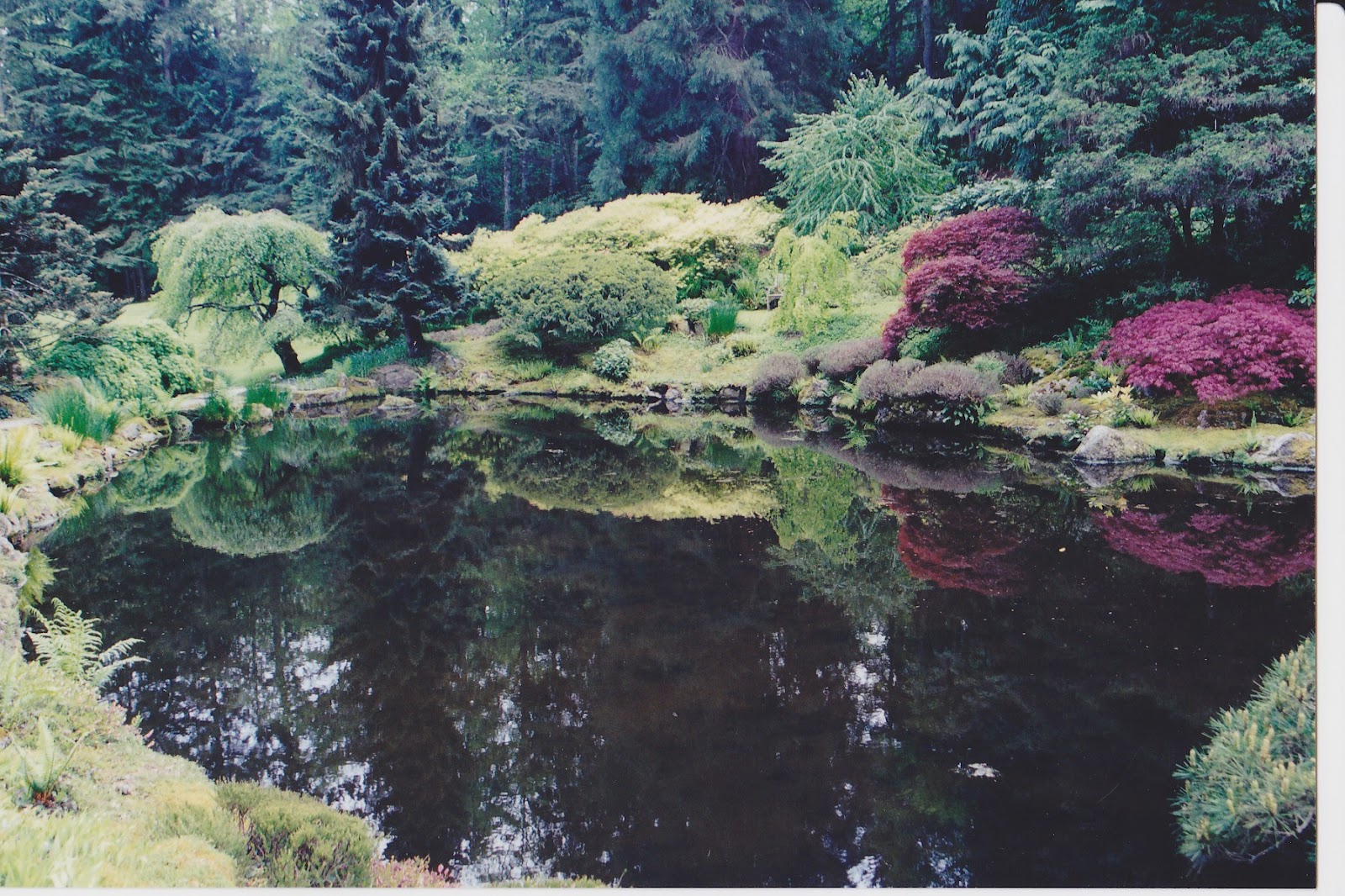
The Reflection pool with its glassy water surface is fed by springs
Next door, is the Moss Garden where a thick green carpet of Irish Moss solidly covers the ground, fallen trees and decaying stumps. Beyond, is the entrance to the Reflection Garden surrounded by a perimeter of neatly clipped English Yew hedges. In the center is the Reflection Pool, a 200’ rectangle fed by natural springs. Its glassy, still surface creates a mirror image of surrounding trees and greenery.
While the Reserve is spectacular in spring with its showy rhodos, azaleas, and wildflowers, October is one of the best times to visit. The colorful fall foliage displays are unparalleled in the Puget Sound area. Japanese maples turn a fiery red and orange, while aspens and tulip trees provide brilliant yellow tones. A Persian Parrot tree features leaves of yellow with red, orange, and purple highlights. The backdrop of dark evergreens enhances the whole fireworks show of bright, wild colors.
The Reserve is easily reached by driving north on I-5 from Olympia, and following US 101 and State Routes 3 and 305 through the Kitsap Peninsula. The park is on the northern tip of Bainbridge Island, just south of the Scandinavian town of Paulsbo. The Island is also accessible by regular ferry service from Seattle.

Sunday, May 20, 2012

Lakewold Gardens: In Search of the Blue Poppy


Himalayan Blue Poppy
The vivid color of its petals has been compared to the blue of Paul Newman’s eyes. Rare and difficult to grow, this flower has earned the reputation as the “elusive butterfly of the garden”. It is indigenous to the sub-Alpine meadows of the Himalayan Mountains in Bhutan, Tibet, China, and Nepal; but, no need to get out your passport or pack your bags to see this marvelous plant. The Himalayan Blue Poppy’s taste for cool, moist summers; shade; and acidic soil means the Pacific Northwest is one of the few places outside its native habitat where the plant can thrive. Lakewold Gardens Estate, just south of Tacoma, bills itself as the spot “Where the Blue Poppy Grows” and is the best place to admire this pretty perennial.

The gardens consist of ten acres of manicured grounds surrounding a Georgian-style mansion on the shores of Gravelly Lake. Considered one of America’s great estate gardens, Lakewold features large collections of Rhododendrons (250 different species), Japanese maples (30 varieties), camellias, and cherry trees along with several gardens within gardens, sweeping lawns, European-inspired parterres, reflecting pool, and gazebo.

Brick pathway connects home and gazebo
The property was first developed in the early 1900s as wealthy Tacomans established summer retreats along the shorelines of a series of lakes south of the city. H.F. and Ruth Alexander, owners of the Admiral Lines, inherited the land, added additional acreage, and enlisted designers to create a fabulous estate and gardens that would capture the views of Gravelly Lake and Mount Rainier. The Olmstead Brothers, known for their work in public parks of Seattle and Portland, are credited with designing the brick walkway, perimeter fence, and gate.

Reflecting Pool
In 1938, the estate was sold to George Croydon and Eulalie Wagner. He was an established Tacoma businessman with ties to timber and coal production and she was a daughter of the Merrill’s, a prominent Seattle lumber family. With her strong interest in gardening and the arts, she is largely responsible for the look of the garden today. She was an avid plant collector, and added a sizeable collection of choice and rare plants, including the blue poppy, to the grounds.

Thomas Church, a nationally recognized landscape architect, visited the property many times between the 1950s-1970s and greatly influenced the garden design including the pool and teahouse. His emphasis on multiple vantage points and a free flow between the house and garden are observable today.

Upon her death in 1987, Mrs. Wagner donated the property to the non-profit Friends of Lakewold so the gardens could be preserved, maintained, and enjoyed by the public.

Visiting Lakewold seems more like an excursion to someone’s private estate than a public garden. The self-guided tour begins along the Circle Drive leading to the house through a forest of tall rhododendron. The Wagner House, built in the Georgian revival style, is also open to the public and serves as a popular venue for weddings and meetings. Beyond the home’s glassed sun room, an intricate brick pathway leads to the gazebo, or tea house. On both sides, neatly trimmed boxwood hedges surround topiaries and create parterres, small patterned gardens. Next to the rose-covered gazebo is an unusual, decorative swimming pool designed by Thomas Church. He is also responsible for the medieval inspired Knot Garden, shaped like a ribbon bow and filled with culinary herbs. Other “gardens within gardens” include a rock garden, fern garden, woodland garden built below a giant Douglas fir, rose garden and waterfall.
Knot Garden

A special bonus is the Garden Shop located in the original 1918 carriage house. It offers a unique selection of gardening books, tools, seed packets, and many of the rare plants seen in the garden. The Himalayan Blue Poppy is also available here but only once a year and for a few weeks in the spring. Needless to say, the limited supply sells out quickly.

The month of May is an excellent time to visit Lakewold when the spring bloomers, including the rhododendron, are at their peak. In late May and early June, the blue poppy shows off its spectacular blossom. The garden is open Wednesday through Sunday from 10 am to 4 pm and admission is $9 for adults, $6 for seniors. To check if the poppies are in bloom, call 253-584-4106 or visit their web site, www.lakewoldgardens.org.

Friday, June 10, 2011

I-5 Iris Gardens

Driving south on I-5, just beyond the Brooks Exit (between Woodburn and Salem), look to your right for a bright patch of colors.  At 70 miles an hour, it's only a blur, so take the time and exit at Brooks for an amazing, free, visual treat. From the exit, head west to the first stop sign and turn south (left) on River Road for about a couple miles to Quinaby Road. Turn left and in a short distance, you'll see the sign on the left for Schreiner's Iris Gardens.


Here you will discover ten acres of the most stunning display gardens; I have visited a number of times and am still awestruck when I first walk into the garden. While irises are the centerpiece of this floral show, other delights include poppies, lupines, peonies, rhodos, and columbines. If you think of irises in terms of blue or yellow, you'll be amazed to see how many hues and color combinations exist.

 The Schreiner family has been growing and hybridizing irises in the Willamette Valley since the early 1920s. They must be doing something right, since they have more medals than Michael Phelps displayed on the walls.


Every spring, they host a show and this year's has been extended until Sunday, June 12 because of the cool, wet growing season. After that, the gift shop and flower sales end, but the garden remains open for exploring. The flowers should last at least another week or two, depending on the weather, and it is well worth the short detour from the freeway.


Thursday, May 5, 2011

Hulda Klager, the Lilac Lady

Imagine losing your life’s work. Imagine having to start all over again. Now, imagine doing all that at age 85. That daunting task faced Hulda Klager when the Columbia River swept over its banks in the flood of 1948, inundating her home and destroying all her beloved lilacs. Hulda, known around town as “The Lilac Lady,” immigrated to the United States from Germany in 1865 at the age of two. Her family eventually settled on a small farm in Woodland, Washington, about 25 miles north of Portland. Their Victorian home, built in 1887, remains on that site today.
While Hulga led a busy life of marriage and motherhood, she always maintained a strong interest in flowers and plants. In 1903, while recuperating from an illness, some neighbors gave her a book by the famous plant hybridizer, Luther Burbank. She was immediately fascinated by the process and set about to create a new apple, one that would be larger and less time-consuming to peel. After that success she turned her attention to lilacs. Within a few years, she had developed many new varieties and became regionally recognized and honored for her achievements. In the spring when the lilacs were in full bloom, she would always open her gardens to the public in what became know locally as Lilac Week.  When the flood destroyed all her plants, Hulga’s neighbors donated starts and clippings from lilacs she had given them, and with determination and hard work, she restored the garden and brought back Lilac Week. After her death in 1960, Hulga’s property with its lovely gardens faced the prospect of being bulldozed and turned into an industrial park. Members of the local garden club rallied to the cause and had the property declared a state and national historic site. One member exchanged 7 acres of land for the 4.5 acres of Hulga’s garden and the property is now in the safe and caring hands of the Hulda Klager Lilac Society. While the gardens are open year round, the ideal time to visit is during the annual Lilac Festival when the bushes are at their full and fragrant best.
The grounds include over 150 varieties of lilacs in all shades of purples from violet to lavender, as well as pinks, whites, and yellows. Many of these varieties, including some developed by Hulga, are available for sale with the profits going to fund the Lilac Society’s efforts in maintaining and restoring the gardens. In addition to the more than 250 lilac bushes, other plants, including rhododendron, camellias, wild flowers, and rare shrubs decorate the property. Trees in the garden were the sole survivors of the flood and are now some of the largest in Washington State.  In front of the house is a colorful Victorian-era garden.
The farmhouse is now open year round from 11 am to 2 pm. Inside, are many of Hulda’s original furnishings along with quilts, antiques and collectibles from the area. The water mark along the wall and a series of old photos dramatize the height and damage of the flood. Costumed hostesses are stationed in the rooms to answer any questions about the furnishings or the remarkable life of Hulda Klager.
This year’s Lilac Festival runs through May 14, 10am until 4pm daily.  The cost to enter the gardens and farmhouse is $2. From Portland, travel north on I-5 and exit at Woodland, Exit 21 and head west, under the freeway; signs show the way to the gardens from there. To learn more about the festival and gardens, visit the web site at www.lilacgardens.com, or call 360-225-8996 to check on the status of the blossoms.

Monday, February 28, 2011

Victoria: A Bit of Britain on the Pacific Coast

Where else can you go whale-watching in the morning and savor a proper high tea in the afternoon? Only in a spot where Mother Nature and a cosmopolitan city share the same place, and Victoria, BC, at the southern end of Vancouver Island, fits the description.
Getting there is part of the adventure and a good choice for those who want to leave their car at home is the Victoria Clipper, a ferry service out of Seattle’s Pier 69. Several daily departures offer comfortable seating, meal and beverage service, duty-free shopping and clean, but compact, restrooms. Huge picture windows provide excellent views of Whidbey and Bainbridge Islands, and the mountains on Washington’s Olympic Peninsula. The trip takes a little under three hours and docks at Victoria’s Inner Harbour within walking distance of several hotels and almost all the major attractions. While the town can be done as a long day trip, it’s much better to spend at least one overnight.
The Tourist Information Center on the north side of the Inner Harbor is a great place to begin a visit, and load up on advice, maps, and brochures. Most points of interest are in the Inner Harbour area, making Victoria an immensely walkable city. This part of town is the perfect place for strolling, people-watching, and enjoying the many street performers- musicians, mimes, jugglers, and comedian wannabes.


Impossible not to notice is the vine-covered, majestic Empress Hotel across Government Street from the visitor center. Built in 1908, the hotel is a throw-back to a more glamorous travel era when the Canadian Pacific Railroad brought travelers and businessmen across Canada in style to Victoria. Here, they stayed at the Empress (owned by the railway) before boarding the ocean liners (also owned by the railway) to sail westward across the Pacific to ports in Asia.
The hotel, thoroughly remodeled in 1996, is noted for its traditional, afternoon tea served in Edwardian splendor in the Tea Lobby overlooking the harbor. Their proprietary, blended tea is served in fine Royal Doulton china cups and accompanied by freshly baked raisin scones, clotted cream, strawberry preserves, a selection of dainty tea sandwiches, and an array of tasty pastries. A dress code is enforced so don’t expect to drink tea wearing your flip-flops, and be prepared to pay about $50.
Across the street from the Empress is the Royal BC Museum, one of Canada’s best regional museums. It interprets several thousand years of natural and human history through dioramas, street scenes, hands-on exhibits, and even a replica of Capt. George Vancouver’s ship. Of special note is the First Peoples Gallery with its impressive collection of native artifacts including some amazing masks. Outside, in a small green space, is Thunderbird Park with a display of intricately carved totem poles and a ceremonial longhouse. 
Next door to the museum are the manicured grounds and beautiful buildings housing the British Columbia legislature. Referred to as the Parliament Buildings, they were constructed between 1893 and 1898, and designed by Francis Rattenbury, architect for the Empress Hotel. Free thirty minute tours of the interior give a glimpse of the stunning stained glass windows and ornate rotunda, but one of Victoria’s best kept secrets is hidden in the basement of the building. It’s a lunchroom open to the public from 9-3 during weekdays and serves delicious sandwiches and salads in a white tablecloth environment at reasonable prices. You need to check in with security at the entrance; after all, you will be rubbing shoulders with provincial politicians.
Another must-see sight is not in the walkable Inner Harbour, but about 13 miles north. There are numerous sightseeing busses and shuttles happy to take visitors to the Butchart Gardens, and public transportation is available as well. The gardens, covering more than 50 acres, were the idea of Jennie Butchart, wife of cement baron Robert Butchart. Offended by the sight of a nearby, abandoned quarry, she brought in topsoil from local farms and transformed it into a stunning Sunken Gardens. Over the years, an Italian Garden and English Rose Garden were added. Today, the gardens host over one million visitors a year and many consider it Victoria’s number one attraction.


Sunday, June 6, 2010

City of Roses

It’s June and the City of Roses is gearing up for another Rose Festival, another Grand Floral Parade, and another year of celebrating the city’s best known flower. When locals and out-of-towners want to stop and smell the roses, they generally head for the International Rose Test Garden in Washington Park. But, Portland has another rose garden; one that is older and bigger, but not as well known.
Located in the Piedmont neighborhood in North Portland, Peninsula Park is bordered by Rosa Parks Way on the north and Ainsworth Avenue on the south with Albina and Kerby forming the east and west sides. The inspiration for the park was the City Beautiful Movement of the early 1900s, a nationwide effort at urban revitalization aimed at making cities more attractive and appealing places with parks, recreational opportunities, and community pride. While Portland lacked the industrial blight of older, Eastern cities, it was experiencing a period of rapid growth and expansion and prime for some urban development. The city responded by hiring the Olmsted Brothers, the premier landscape architects of that time, to visit the city and develop an open space and park plan. Their contributions continue to be enjoyed today in many of the city’s most popular parks- Forest, Washington, Laurelhurst, Sellwood, Mt. Tabor, Westmoreland, Peninsula and others.
The 16-acre parcel of land designated for Peninsula Park was purchased in 1909 for $60,000 and, according to the Department of Parks and Recreation, was formerly the site of a roadhouse and horse racetrack owned by businesswoman Liverpool Liz. When completed in 1913, the land was transformed into an outstanding example of a neighborhood park of that era, and included a community center with swimming pool, children’s playground, and Portland’s first public rose garden.
The two acres devoted to the garden were laid out in a formal, classic, European-style with symmetrical rows, neatly trimmed boxwood hedges outlining the flower beds, brick pathways, and a large water fountain and pool in the center. The sunken garden was situated six feet below street level and contained nearly 9,000 roses representing 65 varieties. The official rose of Portland, Mme. Caroline Testout, was cultivated here and can still be seen growing in the garden. This deep pink rose was extremely popular at the turn of the century. After World War I, the city planted 10,000 of them along 20 miles of street ways; thus earning the moniker, City of Roses.
Overlooking the garden is an ornate, octagonal band shell built in 1913. It served as the setting for patriotic rallies during World War I and is now a popular venue for summer weddings and concerts. The last of its kind in Portland, the building is a National Heritage Historical Structure and official Portland Historic Landmark.
When the rose garden first opened in 1913, it was an immediate hit and received over 300,000 visitors in the first year. Floral enthusiasts made it the home of the annual rose show. In the meantime, the city with the support of the American Rose Society was developing a rose test garden in Washington Park on Portland’s west side. When the International Rose Test Garden opened in 1917, rose festival activities moved there leaving Peninsula Park’s lovely garden to enjoy its quiet, neighborhood ambiance.
While on the eastside of town, another place to view an outstanding assortment of roses is in the Ladd’s Addition Rose Gardens. This urban, residential neighborhood in southeast Portland off Hawthorne Avenue was originally laid out in 1891. While most of the area streets are on a grid system, the Ladd’s Addition consists of diagonal streets extending outward from a central park. At each of the four compass points are diamond-shaped rose gardens with a total of 3,000 plants.
Not in Portland, but another charming rose garden on the eastside is the Sara Hite Memorial Rose Garden located on Kellogg Creek Road in the southeast suburb of Milwaukie, across from the Milwaukie Senior Center. With over 450 rose bushes in neatly manicured beds, the garden also features a lovely gazebo, large brick plaza, and plenty of benches for stopping and smelling the roses.

Thursday, April 1, 2010

Where Rhodies Rule

It’s that time of year when large clumps of pink and purple flowers begin showing off in front yards throughout Pacific Northwest neighborhoods. Our mix of moisture, mild weather, and acidic soil, make this region a Rhododendron paradise.
The plant’s diversity is amazing. With a native habitat ranging from 19,000’ alpine meadows in Nepal to tropical regions in Northern Australia and the wind-swept coast of Scotland, the rhododendron exhibits a wide variety of colors, shapes, and sizes. The blooming season can extend from early January to mid-summer, but April and May are the peak times for most of our local plants. Fortunately, there are a number of outstanding public and private gardens in the Pacific Northwest dedicated to this species.

Best known in the Portland area is the Crystal Springs Rhododendron Garden located in the southeast section of the city, between Reed College and the Eastmoreland Golf Course. Once an overgrown, abandoned patch of brambles and brush, the garden was co-founded in 1950 by the Portland Chapter of the American Rhododendron Society and the city Parks and Recreation department. Today, its seven acres include winding paths, a spring-fed lake, waterfalls, bridges, and a wide variety of birds and waterfowl. With over 2500 rhododendron, azaleas, and companion plants, the garden offers a dazzling display of color this time of year.
 I visited the park today and many of the plants are displaying their full glory while others are still thinking about it. Happening this weekend (Saturday April 6) is the Early Show and Plant Sale. Check it out.

Thursday, March 4, 2010

Portland's Japanese American Historical Plaza

With Spring so early this year, it's almost time to check out one of Portland's most spectacular floral displays....the 100 blooming, Akebono cherry trees lining the north end of the Tom McCall Waterfront Park. Their beautiful double pink blossoms form a brilliant floral canopy, and are a welcome harbinger of spring, marking the end of a long, gray winter.
 The trees, planted in two parallel rows, were a gift to the city from the Japanese Grain Importers Association and decorate the waterfront side of the Japanese American Historical Plaza.


Dedicated in August, 1990, to the memory of Japanese Americans deported to internment camps during World War II, the Plaza extends along the Willamette River and Naito Parkway between the Burnside and Steel Bridges. This award-winning park was designed by landscape architect Robert Murase, himself an internee at age four. It was the first memorial to the Japanese interment in the country and was funded and promoted by the efforts of the Oregon Nikkei Endowment and Portland businessman and real estate developer, Bill Naito.

The main entrance from Couch Street is framed by two large copper columns, each depicting carved images of the Japanese American history in the Northwest. The one on the left shows an elderly man holding a child; the right one features children on a train to an internment camp and a mother and child guarded by a camp sentry.

Beyond the columns, a collection of large boulders follows a serpentine line next to the river walkway and cherry trees. The stones are carved with poems written by Lawson Inada, a professor of English at Southern Oregon University, and touchingly tell the story of local Japanese Americans. Some of the stones are broken, some shattered to represent the disrupted lives of internees. One large boulder lists the names of the different internment camps and another one displays a plaque with the Bill of Rights, an ironic reminder of the laws designed to protect the rights of all citizens. Not far away, is a plaque with a copy of the official Congressional apology to each of the 60,000 surviving Japanese American internees signed by President Reagan in 1987. At the far end of the Plaza, near the foot of the Steel Bridge is the Friendship Circle. Two tall stainless steel columns soar from a circular garden, celebrating the Portland and Sapporo, Japan, sister city relationship.

West of the Plaza is the neighborhood known today as Old Town, but it was once the center of a thriving Japanese American community called Nihonmachi, or Japantown. At the end of the 19th century, large numbers of Japanese workers immigrated to the Pacific Northwest to work in farms, orchards, salmon canneries, and railroads. By 1905, more than 25,000 called Portland home. A bustling, business community developed in this area with its own newspaper, grocery stores, theaters, shops and restaurants.

All that came to an end on February 19, 1942 when President Franklin Roosevelt issued Executive Order 9066 directing the military to incarcerate all persons of Japanese ancestry on the West Coast. Portland families were sent to what had been the Pacific International Livestock Expo Center and from there to various relocation camps scattered throughout remote, rural areas of Idaho, Wyoming, and California. Japantown never recovered, and as one of the poems engraved on a stone in the Plaza reflects: Just over there was our community. Echoes! Echoes! Echoes!

Today, the history of the local Japanese American community is told at the Oregon Nikkei Legacy Center located at 121 NW Second Avenue, between Couch and Davis Streets in the old Merchant Hotel. Its exhibits, artifacts, and photos highlight the experiences of first generation immigrants called Issei, the development of Japantown, and the forced internment during World War II.

Monday, January 4, 2010

Lan Su Chinese Garden


When it comes to gardens, there is more than an ocean’s worth of difference in Western/European and Asian concepts. While our Western ideas of garden design may include neatly trimmed hedges, showy blossoms, expanses of green lawn, statuary, or mathematically ordered plantings, a traditional Asian garden is something entirely different. In Portland, the two counterparts live side by side in Washington Park with the International Rose Garden and Japanese Garden exemplifying these very different styles.


Over the years, Japanese gardens have become plentiful and popular in this country, but Chinese gardens are somewhat new and unfamiliar. There are only nine public Chinese gardens in the U.S and Portland is fortunate to have an outstanding representative. The Portland Classical Chinese Garden developed from the sister-city relationship with Suzhou, China, an ancient town near Shanghai, famous for its many gardens. Although the idea of creating a traditional, Suzhou-style scholar garden in Portland had been discussed for some time, it wasn’t until NW Natural offered the city a downtown block of land used as a parking lot that the dream became a reality. Construction, including the importing of 500 tons of rock and a team of artisans from China, began, and the garden opened to the public in 2000.


While occupying only one city block in the Old Town section, the walled garden manages to encapsulate the scholar-style gardens from the Ming Dynasty (1368-1644 AD). The traditional, required elements of rocks, water, plants, architecture and poetry work together to create a place for contemplation of nature.


The rocks, quarried from China’s Lake Tai and highly desired for their rough texture, shape and holes are piled at one end of the garden to represent mountains. The strength and solidity of the rocks are balanced by water, and Lake Zither in the center of the garden reflects the changing sky above. Plants including bamboo, pine, rhododendron, camellias, chrysanthemums, and peonies were selected for their symbolism as well as beauty. Architecture, as the primary element of design, is featured by several pavilions, open-style buildings, and a teahouse connected by a series of paths and bridges. Since poetry writing and recitation were essential to a scholar’s garden, many of the doorways and buildings are marked with literary inscriptions. All of the elements combine to create a spot of tranquility and beauty far removed from the 21st-century city beyond the walls.


In celebration of their 10-year anniversary in 2010, the garden is changing its name and is no longer known as the Portland Classical Chinese Garden, but the Lan Su Chinese Garden. The new name is a combination of  "Lan" meaning Portland and "Su" for Suzhou. For the first ten days of January, admission is free so be sure to take advantage of this freebie.