Showing posts with label Puget Sound Region. Show all posts

Sunday, May 24, 2015

Tacoma Celebrates Its Native Son


While you can find Dale Chihuly’s amazing glasswork all over the world in famous museums, botanic gardens, and office buildings, but nowhere is it more accessible and abundant than in his hometown of Tacoma, Washington.
Chihuly, born in 1941, grew up in Tacoma, studied interior design at the University of Washington, and narrowed his focus to glass art at the University of Wisconsin. While on a Fulbright Fellowship in Venice, Italy, he first observed the team approach in glass blowing to create large-scale pieces. Utilizing this concept, he cofounded the Pilchuck School of Glass outside Seattle, and began producing large, multicolored, glass art works. He established the glass department at the prestigious Rhode Island School of Design and taught there for many years. Today he is considered the world’s premier glass artist and has made the Northwest a world center for glass art.

In Tacoma, many of his pieces are concentrated in an area known as the Museum District, a few blocks along Pacific Avenue adjacent to downtown. The Museum of Glass, Tacoma Art Museum, Bridge of Glass, and Federal Courthouse all feature Chihuly’s work. The best introduction to his style would be a stroll across the Bridge of Glass, a 500-foot span connecting the Museum of Glass and the plaza area of the Washington State History Museum on Pacific Avenue. The pedestrian-only bridge
showcases three Chihuly installations including two 40-foot, blue, translucent crystal towers. While they appear to be crafted from glass, they are made from a polyurethane material designed to withstand the elements. The main feature, however, is a tunnel called Seaform Pavilion. Inside, the ceiling displays over 2000 colorful, amorphous-shaped pieces of glass inspired by marine life in Puget Sound. On a sunny day, the sight is spectacular. Along the sides of the tunnel, are 109 glass sculptures, mostly Art-Deco style floral arrangements.

The bridge ends in a plaza adjacent to the Museum of Glass, easily identified by its silver, angled, conical shape. The museum houses a permanent collection of contemporary glass, and contains an amphitheater called the Hot Shot where visitors can observe a team of artists demonstrating glass making and glass blowing. There’s an on-site café, an excellent gift shop with unique glass items, and outside the doors, a mammoth, clear acrylic sculpture called Water Forest.

Back across the bridge, on Pacific Avenue, is the old Union Station, another successful historic preservation story. Built in 1911, it was praised as “…the most beautiful passenger station in the Pacific Northwest.”  With the demise of train travel, the station closed and the
dilapidated, aging facility was sold by Burlington Northern to the city of Tacoma for $1.00. After three years of renovation, the beautiful Beaux Arts building reopened as the U.S. Federal Courthouse. The interior is every bit as attractive as the outside and is decorated with examples of Chihuly’s glass work.  A colorful chandelier is suspended from the rotunda’s domed ceiling, and bright orange flowers cover the arched, north-facing window.  Altogether, the lobby area features five major installations.

Next door to the courthouse, is the Tacoma Art Museum. Nationally recognized for its collection of Northwest art, the museum has an entire gallery devoted to Chihuly pieces, many donated by the artist. Within walking distance of the Museum District, additional Chihuly installations can be seen at the University of Washington-Tacoma library which houses a striking red chandelier, and at the nearby Swiss Restaurant and Pub with an array of Venetian glass pieces above the bar.

Visiting these places requires a bit of pre-planning. The art museum is closed Monday, and the Union Station Federal Courthouse is only open on weekdays, leaving Wednesday, Thursday, and Friday the best times to visit. A picture identification is required to enter the courthouse. While the bridge and courthouse are free, there is an admission charge at both museums. A pass is available ($35 for seniors) that includes these two museums, the Washington State History Museum and the nearby LeMay-America’s Car
Museum, and Children’s Museum.

You can learn more about Chihuly and his works and these museums as the following websites:


Friday, January 30, 2015

Seattle's Olympic Sculpture Park


Typewriter Eraser, Scale X
Among the items in the bin of obsolescence, you’ll find rotary phones, cassette tapes, carbon paper, hardbound encyclopedias, and a funny little round, rubber circle with a plastic brush attached.  Remember the typewriter eraser?  It has not been forgotten by the famed husband/wife team of Claes Oldenburg and Coosje van Bruggen who created a whimsical, 19-foot sculpture of stainless steel and fiberglass called Typewriter Eraser, Scale X for the Seattle Art Museum’s Olympic Sculpture Park.

Located on the waterfront north of downtown in the Belltown neighborhood, this nine-acre park combines landscaping, art, and a stunning view of Puget Sound and the snow-capped Olympic Mountains to create an urban redevelopment success story. The site was previously occupied by Union Oil of California as a transfer facility and tank farm. When they pulled out in the 1970s, they left behind a blighted, industrial eyesore with soil contaminated by years of oil seepage.

The idea of creating a sculpture park in this wasteland grew out of a collaboration between the Trust for Public Land and the Seattle Art Museum. Sufficient funds were raised to purchase the land, clean up the contamination, and engage the New York architectural firm of Weiss/Manfredi to transform the property into a vibrant green space to showcase art.

The landscaping, an important element in the design, consists of four Northwest ecosystems: Valley, Meadows, Groves, and Shore. Each is planted with native trees (over 500), shrubs, and wildflowers; and the entire area is connected with a 2200-foot long, Z-shaped, pedestrian path.

Interspersed along this path is a collection of monumental, modern sculptures designed by some of the best-known regional, national, and international artists.  Probably the most recognizable is Alexander Calder’s bright red Eagle which provides a perfect picture frame for Seattle’s Space
Caler's Eagle
Needle.  Other noted artists represented in the collection include Mark di Suvero, Richard Serra, and Louise Bourgeios. The twenty-plus sculptures are mostly metal and abstract including benches mimicking eyeballs, curving monoliths in oxidized steel, and a 50-foot tall stainless steel tree.

One unusual piece brings together art and science. The Neukom Vivarium consists of an 80-foot greenhouse occupied by a giant, dead “nursery log” where viewers can observe life and decay amid the ferns, lichens, and insects that have made the tree their home.

The park is open all year and is free to the public. In summer months, a café serves espresso and snacks, and the park’s amphitheater hosts a variety of special concerts and other events.
Love & Loss
 

Thursday, January 2, 2014

Port Gamble: Where the Past is Always Present


Turn onto Rainier Avenue in Port Gamble, Washington, blink twice, and you’d swear you had been transported to a tree-lined village in New England. And, you wouldn’t be entirely wrong.

In 1853, Maine lumbermen, Andrew Pope and William Talbot, sailed around Puget Sound seeking the right place for a Northwest logging outpost for their successful San Francisco- based timber and shipping company. They chose a small harbor off the Hood Canal, brought in mill machinery, and constructed a saw mill, bunkhouse, store, and cookhouse. Named Port Gamble, it became one of several successful, company-owned logging towns taking advantage of the plentiful, first-growth forests around the Olympic Peninsula.

When gold was discovered in the Klondike, workers abandoned their lumber jobs to seek fortunes in Alaska. It was obvious to the company that married men would provide a more stable, dependable workforce.  Pope and Talbot sought to recruit workers from their hometown of East Machias, Maine, and to lure them into taking the long trip west, they recreated the town on the shores of Puget Sound. A proper church, school, and Victorian frame houses complete with picket fences and lawns transformed the rough sawmill town into a little bit of New England in Washington State.

The mill and town thrived and timber from Port Gamble was shipped to ports all over the world including Australia, Hawaii, and England. However, by the late 20th century, overharvesting, economic downturns, and some bad business decisions forced the company to shut down the mill in 1995. It was the oldest continuously operating mill in North America.

However, the company (now called Pope Resources) recognized the unique value of the town, and poured money into restoring the community to its former glory days.  The only remaining company owned town in Puget Sound, Port Gamble is now listed as a National Historic Landmark with tourism replacing timber as the main business.  The homes, commercial buildings, common outdoor areas, and water/sewer system are all owned by Pope Resources and are leased rather than bought and sold.

A good place to begin a visit is the General Store. In the downstairs level, is the Port Gamble Historic Museum (open May through October) where local history is interpreted through a number of realistic tableaux. On the mezzanine, is Of Sea and Shore Museum featuring a remarkable collection of seashells, part of one of the world’s largest private collections. The store, dating back to 1916, sells everything from candy to
sweatshirts, and houses an excellent restaurant serving breakfast and lunch.  Get there early as it is quite popular, but a good alternative is the award-winning Mike’s Four Star BBQ located nearby in the former service station.

The main street is lined with a number of attractive, frame homes and commercial buildings now occupied by antiques shops, retail stores, and a tearoom. You can’t miss the grandiose Walker-Ames house, next door to the General Store. The Queen Anne mansion, built for the mill manager, faces the bay so ship captains would spot it first. Today, it has a reputation for being haunted with mischievous ghosts residing in the basement.

Walker Ames House
Beyond the iconic, wooden water towers, sits the St. Paul’s Episcopal Church, also a company-owned property. Built in 1879, its Gothic windows and needle spire are reminiscent of the Congregational church in East Machias, Maine. The church and a new pavilion overlooking the water have made Port Gamble an increasingly popular wedding destination.

To reach Port Gamble from the south, follow Interstate 5, US Hwy. 101 from Olympia, and Wash. Hwy. 3 past Bremerton and Silverdale. If you want the ferry experience, take the Seattle-Bainbridge Island or, further north, the Edmonds-Kingston ferry.  Other sites nearby include the neighboring town of Poulsbo known for its Norwegian roots, and the Victorian city of Port Townsend. Or, make your stop in Port Gamble a launching pad for a visit to the Olympic Peninsula.

A handy and comprehensive “Walking Tour of Historic Port Gamble” with map, photographs, and descriptions may be downloaded from the following website:  www.portgamble.com.

Wednesday, June 13, 2012

Bloedel Reserve


When wealthy lumber baron, Prentice Bloedel, donated this property on Bainbridge Island, west of Seattle, it was with the set purpose of “creating a place where people could enjoy natural beauty through peaceful walks in the gardens and woodlands.”
The path wanders through a stand of Himalayan Birch.
A well-manicured path winds an easy 1 ¾ miles through the Reserve passing formal gardens, ponds, native forests, wildlife habitats, Japanese and moss gardens. The blending of Asian and European gardening and landscaping styles is most evident and a unique feature of the Reserve.
The path begins by cutting through a meadow of knee-high grass before entering the forest and skirting around a woodland pond. In this bird sanctuary ducks, geese, and a pair of trumpeter swans swim peacefully, surrounded by native sedges and ferns. The trail continues through a dense forest of western red cedars and Douglas firs before emerging onto the property’s formal European garden. 
The Bloedel home now serves as the Visitor Center.

Here, a sculpted lake, complete with requisite weeping willows and white swans, and wide green lawns create a stunning setting for the Visitors Center, the former home of the Bloedels. This French country manor, on a bluff overlooking Puget Sound, was built in 1931 and purchased by Prentice and Virginia Bloedel in 1951. They immediately set about transforming the 150 acres into the beautiful, natural habitat and showcase of gardens that exist today. During their lives, the couple was active in the Seattle art community and the Reserve became a popular retreat for artists and writers. The house’s ground floor with its original furniture and paintings is open to visitors.
Strolling Pond Garden
From the house, the trail winds through plantings of magnolias, rhododendrons, azaleas, birch trees, and large displays of primroses and cyclamen, eventually leading to the Japanese Garden. In the center of this garden is the guest house, an unusual amalgam of Japanese style and Northwest Native American longhouse. The teak floor inside was salvaged from the decks of the USS New Jersey.  Behind the house, a sand and stone garden of carefully placed rocks and raked pebbles is reminiscent of a Zen meditation garden. The deck of the house, offers an overall view of the Strolling Pond encircled by lacy leaf maples and pruned black pines. 
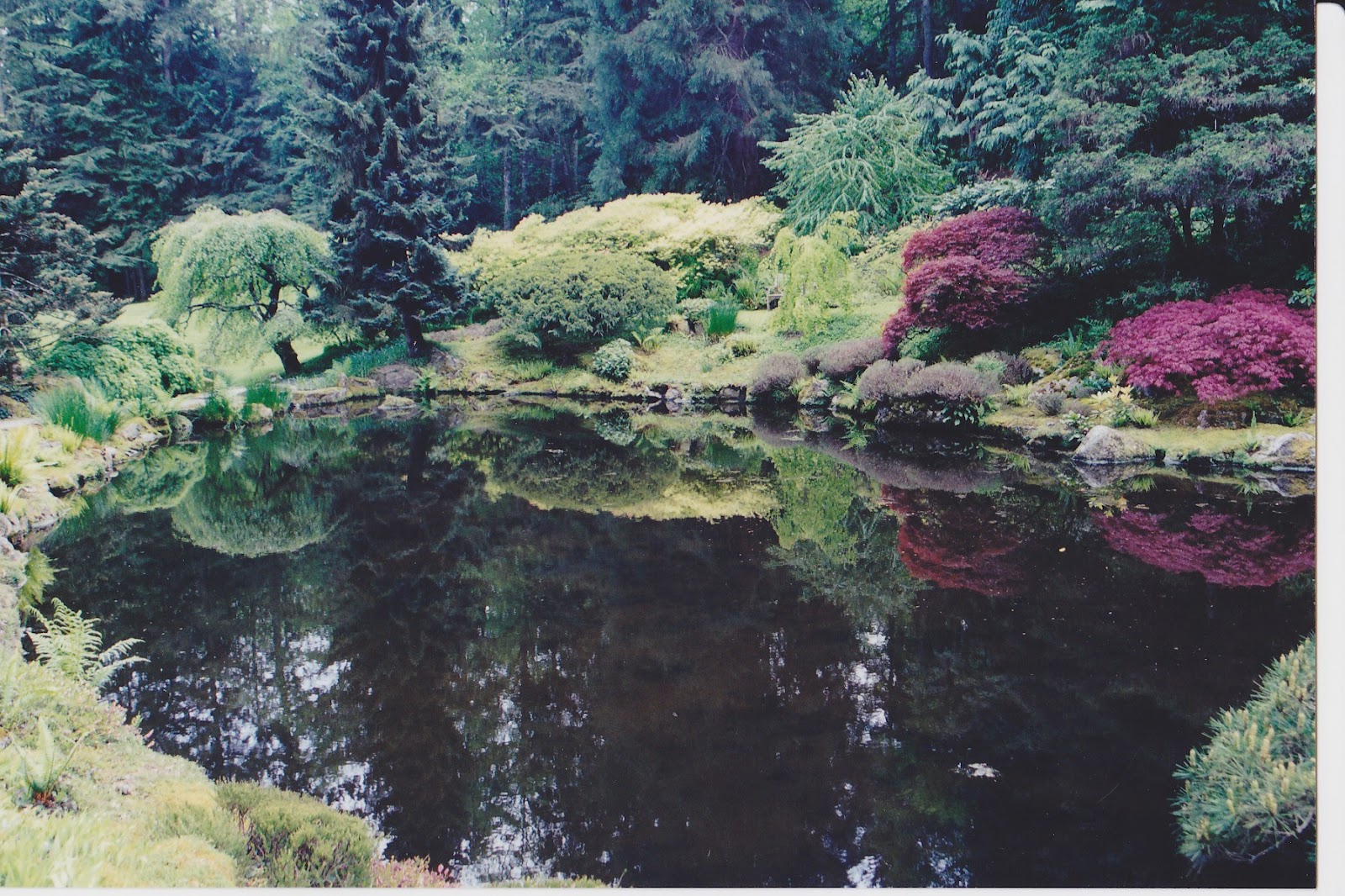
The Reflection pool with its glassy water surface is fed by springs
Next door, is the Moss Garden where a thick green carpet of Irish Moss solidly covers the ground, fallen trees and decaying stumps. Beyond, is the entrance to the Reflection Garden surrounded by a perimeter of neatly clipped English Yew hedges. In the center is the Reflection Pool, a 200’ rectangle fed by natural springs. Its glassy, still surface creates a mirror image of surrounding trees and greenery.
While the Reserve is spectacular in spring with its showy rhodos, azaleas, and wildflowers, October is one of the best times to visit. The colorful fall foliage displays are unparalleled in the Puget Sound area. Japanese maples turn a fiery red and orange, while aspens and tulip trees provide brilliant yellow tones. A Persian Parrot tree features leaves of yellow with red, orange, and purple highlights. The backdrop of dark evergreens enhances the whole fireworks show of bright, wild colors.
The Reserve is easily reached by driving north on I-5 from Olympia, and following US 101 and State Routes 3 and 305 through the Kitsap Peninsula. The park is on the northern tip of Bainbridge Island, just south of the Scandinavian town of Paulsbo. The Island is also accessible by regular ferry service from Seattle.

Sunday, May 20, 2012

Lakewold Gardens: In Search of the Blue Poppy


Himalayan Blue Poppy
The vivid color of its petals has been compared to the blue of Paul Newman’s eyes. Rare and difficult to grow, this flower has earned the reputation as the “elusive butterfly of the garden”. It is indigenous to the sub-Alpine meadows of the Himalayan Mountains in Bhutan, Tibet, China, and Nepal; but, no need to get out your passport or pack your bags to see this marvelous plant. The Himalayan Blue Poppy’s taste for cool, moist summers; shade; and acidic soil means the Pacific Northwest is one of the few places outside its native habitat where the plant can thrive. Lakewold Gardens Estate, just south of Tacoma, bills itself as the spot “Where the Blue Poppy Grows” and is the best place to admire this pretty perennial.

The gardens consist of ten acres of manicured grounds surrounding a Georgian-style mansion on the shores of Gravelly Lake. Considered one of America’s great estate gardens, Lakewold features large collections of Rhododendrons (250 different species), Japanese maples (30 varieties), camellias, and cherry trees along with several gardens within gardens, sweeping lawns, European-inspired parterres, reflecting pool, and gazebo.

Brick pathway connects home and gazebo
The property was first developed in the early 1900s as wealthy Tacomans established summer retreats along the shorelines of a series of lakes south of the city. H.F. and Ruth Alexander, owners of the Admiral Lines, inherited the land, added additional acreage, and enlisted designers to create a fabulous estate and gardens that would capture the views of Gravelly Lake and Mount Rainier. The Olmstead Brothers, known for their work in public parks of Seattle and Portland, are credited with designing the brick walkway, perimeter fence, and gate.

Reflecting Pool
In 1938, the estate was sold to George Croydon and Eulalie Wagner. He was an established Tacoma businessman with ties to timber and coal production and she was a daughter of the Merrill’s, a prominent Seattle lumber family. With her strong interest in gardening and the arts, she is largely responsible for the look of the garden today. She was an avid plant collector, and added a sizeable collection of choice and rare plants, including the blue poppy, to the grounds.

Thomas Church, a nationally recognized landscape architect, visited the property many times between the 1950s-1970s and greatly influenced the garden design including the pool and teahouse. His emphasis on multiple vantage points and a free flow between the house and garden are observable today.

Upon her death in 1987, Mrs. Wagner donated the property to the non-profit Friends of Lakewold so the gardens could be preserved, maintained, and enjoyed by the public.

Visiting Lakewold seems more like an excursion to someone’s private estate than a public garden. The self-guided tour begins along the Circle Drive leading to the house through a forest of tall rhododendron. The Wagner House, built in the Georgian revival style, is also open to the public and serves as a popular venue for weddings and meetings. Beyond the home’s glassed sun room, an intricate brick pathway leads to the gazebo, or tea house. On both sides, neatly trimmed boxwood hedges surround topiaries and create parterres, small patterned gardens. Next to the rose-covered gazebo is an unusual, decorative swimming pool designed by Thomas Church. He is also responsible for the medieval inspired Knot Garden, shaped like a ribbon bow and filled with culinary herbs. Other “gardens within gardens” include a rock garden, fern garden, woodland garden built below a giant Douglas fir, rose garden and waterfall.
Knot Garden

A special bonus is the Garden Shop located in the original 1918 carriage house. It offers a unique selection of gardening books, tools, seed packets, and many of the rare plants seen in the garden. The Himalayan Blue Poppy is also available here but only once a year and for a few weeks in the spring. Needless to say, the limited supply sells out quickly.

The month of May is an excellent time to visit Lakewold when the spring bloomers, including the rhododendron, are at their peak. In late May and early June, the blue poppy shows off its spectacular blossom. The garden is open Wednesday through Sunday from 10 am to 4 pm and admission is $9 for adults, $6 for seniors. To check if the poppies are in bloom, call 253-584-4106 or visit their web site, www.lakewoldgardens.org.

Wednesday, March 30, 2011

The Meeker Mansion: The House that Hops Built

Ezra and Eliza Jane Meeker were true Western pioneers. In 1852, they hitched their oxen to a wagon, bundled up their 7-week old baby, and followed the great migration westward across the Oregon Trail. By the time they arrived in Oregon five months later, Ezra had lost 20 pounds, Eliza was so weak she had to be carried up the riverbanks, and they possessed only $3 between the two of them. Nevertheless, they continued their journey north to the Puget Sound area where they struggled to make a living in a number of endeavors. By the mid-1860s, they found their way to a farm east of Tacoma, built a log cabin, and planted a field of hops.
Hop growing was new to the Northwest, but the crop was known since the 11th century in Europe as an important flavoring and stabilizing ingredient in beer. Several disastrous crop seasons in Germany drove up the price of U.S. grown hops and made Meeker a wealthy man. Known as the Hop King of the World, he made many trips to Europe acting as a broker for fellow Washington hop growers. On one occasion, he took along Eliza Jane to England, where she was presented to the royal court and Queen Victoria.
Once exposed to the finery and adornments of royal London, Eliza became a bit dissatisfied with life in a log cabin and decided they needed a house more befitting their station in life. Ezra agreed, but only if Eliza Jane paid for it. Three years and $26,000 later, the impressive 17-room, Italianate Victorian mansion was complete and ready for occupancy.
Only a few years later in the early 1890s, a scourge of aphids wiped out the Washington hops crop and, combined with a national recession, Meeker lost everything. The house remained only because its title was in Eliza’s name. Upon her death in 1909, Ezra left the property and went on to pursue his role as self-appointed Protector and Promoter of the Oregon Trail. The house served as a hospital and was later sold to a Civil War widow’s organization, The Ladies of the Grand Army of the Republic, who ran the place as a retirement home. The property was sold again in 1948 and operated as a nursing home until 1970 when it was handed over to the Meeker Historical Society.
During its years as a medical facility, the beautiful wood paneling and stenciled walls and ceilings were painted over numerous times and a dropped ceiling was added. The Society has worked diligently to restore the house to its former glory and visitors can now enjoy a glimpse of the good life in 1891. Only a few of the furnishings belonged to the Meekers, but all are from that era and the local area.

One of the most striking features of the house is the woodwork. The rooms feature different hardwoods including bird’s-eye maple, ash, cherry and oak in wainscoting, flooring, trim and the main staircase. The ornate stenciling on the ceilings and art tile on the fireplaces are all befitting a woman once presented to the Queen of England.
In the upstairs billiard room, there is a small display of photos showing Ezra Meeker’s many adventures after leaving the house. His concern that the Oregon Trail was disappearing due to negligence and private property development led him on a one-man crusade to mark, map and memorialize the route that had brought him West. Again, at the age of 76, he hitched up a covered wagon with oxen and this time, headed east, following the trail in reverse. During the trip, he installed rock monuments and encouraged others to do the same. He continued to Washington where he met with President Teddy Roosevelt. During his remaining years, Ezra followed the trail four more times: by wagon, automobile, and, in 1924, in an open cockpit biplane. He was planning another trip in a truck built for the occasion by Henry Ford when he passed away at the age of 97.
The Meeker Mansion is located near downtown Puyallup (between Tacoma and Renton), and is open for tours from noon to 4:00 pm, Wednesday through Sunday, after March 1. Admission is $4 (adults) and $3 (seniors). To learn more, visit their website http://www.meekermansion.org/ where you can view a virtual tour through the house, or by calling 253-848-1770.