Showing posts with label arts and crafts. Show all posts

Wednesday, August 6, 2014

Exploring Oregon Caves: Above and Below


 The slogan on the brochure reads: Cool Cave, Warm Hearth!  It’s a clever turn of phrase but, more importantly, captures the concept that Oregon Caves National Monument offers two featured attractions, one natural and one man-made. The park is located about 50 miles southwest of Grants Pass off U.S. 199.  A narrow, winding road leaves the community of Cave Junction and the Illinois River Valley, and climbs upwards through the Siskiyou Mountains to the monument, about 20 miles.
Cave Entrance


The caves (actually, it is only one cave, but has numerous side passageways) were discovered by white settlers in 1874 when hunter Elijah Davidson’s dog, Bruno, followed a bear into a narrow opening in the hillside. However, the cave began life over 200 million years ago as a tropical reef in the Pacific Ocean, and by a series of complex geologic events, combined with years of water erosion and mineral deposits, evolved into one of the very few marble caves in the world.

Ranger-led tours through the cave are offered between late April and early November and cover a little over a half mile in 90 minutes. In this remarkable subterranean world, visitors are introduced to the geology,
The "Banana Grove"
history, wildlife, and view a variety of calcite formations: stalagtites, stalgmites, soda straws, moonmilk, popcorn. The trip is described as moderately strenuous and includes 500 stairs, some uneven and wet, as well as a few low and narrow passageways. The cave temperature is 44 degrees so a warm jacket is welcome even on a hot summer day.

Across from the cave entrance and Visitor Center sits the park’s man-made attraction, a rustic, wooden lodge known as The Chateau, a National Historic Landmark. From the entrance it appears to be a two-story structure with a steep pitched roof and dormer windows, however, it is actually six stories tall.  This unusual design reflects the challenging and limited building site it occupies, a ravine with a creek running through it.  Construction began in the early 1930s during the height of the Depression. Local contractor, Gust Lium, chose a style coined by Frank Lloyd Wright as “organic
The Chateau entrance
architecture,” promoting harmony with the environment and utilizing local construction materials. In the end, he created a building of natural charm and elegance, well adapted to its setting, with a great sense of place; a “green” structure long before it was eco-fashionable.

The exterior is covered with Port Orford cedar bark creating a shaggy, textured façade while the interior lobby features a massive, double marble fireplace; exposed wooden beams supported by 30-inch diameter, Douglas fir posts; and a staircase of local madrone, oak, and pine. Downstairs from the main lobby is the dining room, gift shop, and a 1930s diner-style café; 23 guest rooms occupy the two floors above the lobby.

waterfall and reflecting pool
One of the most unusual features of the building is the presence of the stream accumulated from dripping surface water inside the cave. There, it is called the River Styx, but once it emerges from the cavern it assumes the less intriguing name of Cave Creek, and flows over a man-made waterfall in front of the Chateau into a picturesque, reflecting pool. From there, it travels into the building, through the dining room, and then out to the canyon on its journey to the Illinois River. 

1930s Coffee Shop
This design plan had an unfortunate consequence in the winter of 1964 when heavy storms, snow and rain combined to release a flood and avalanche that ripped through the bottom floors of the Chateau creating a swath of structural damage and debris. While many considered the building an insurance write-off, others, including original builder Lium, worked tirelessly to save and restore the property.

Today, visitors can enjoy the charming ambiance of one of the Great Lodges of the National Parks from the attractive lobby, restaurant options, and inviting guest rooms.  Both the public and private rooms are decorated with the largest collection of Monterey furniture, a uniquely American, arts- and-crafts style characterized by leather and metal detailing, distressed wood, and painted designs.

Example of the Chateau's collection of Monterey furniture
Throughout the lodge, the emphasis is on local.  The gift shop offers crafts from southern Oregon artists including jewelry, prints, wooden items, jams, soaps, and textiles. In the dining room, the menu is filled with locally sourced meats, fish and produce.  (Be sure to try the bison meatloaf!) The quirky, retro café with its serpentine countertop serves hearty breakfasts, sandwiches, and old-fashioned milkshakes. Even the people waiting on you are local.

Learn more about a visit to Oregon Caves or make reservations for a stay at the Chateau by visiting these websites: Oregon Caves Cheateau and Oregon Caves National Monument.


Monday, May 26, 2014

The Many Murals of Estacada

For some 20,000 years, humankind has been attracted to the bare wall as a canvas for artistic expression. From the caves of Lascaux in southwestern France where primitive men drew the animals of their known world to the satirical stencilings of British graffiti artist, Banksey, murals have been a popular art form and means of communication. They are considered one of the oldest artistic endeavors and even here, in the Pacific Northwest, native tribes along the Columbia River left art work in the form of petroglyphs that are still visible today after hundreds of years.
The outdoor wall mural has been chosen by a number of small Northwest towns as a strategy for economic development and beautification with Chemainus, British Columbia, as the most noted example. A dying logging community on Vancouver Island, it transformed itself into a huge outdoor art gallery drawing tourists from around the world.  Taking a cue from its northern neighbor, the town of Vale in Eastern Oregon painted 30 empty walls with tales from the Oregon Trail as a way to attract travelers along Interstate 84. Toppenish, Wash., Cottage Grove, Silverton, Springfield, and The Dalles have all dressed up their towns with colorful murals.

A good example closer to Portland, is the town of Estacada, about 35 miles southeast along the banks of the Clackamas River, at the edge of Mt. Hood National Forest. Rather young by Oregon standards, the community was founded in 1905 after a rail line was built to support construction of a series of hydroelectric dams upstream along the Clackamas River. The railroad also serviced a thriving logging and milling industry and the owners of the line (Oregon Water Power and Railway Company) built a grand hotel and park to lure Portland tourists. On weekends, city dwellers rode the electric streetcar out to Estacada or further along the route to Cazadero for an enjoyable day of picnics, fishing, and chicken dinners at the Hotel Estacada.

Over time, the dams were completed, the logging industry faded, the hotel burned down, and the town began to fade as the local economy stagnated. In 1992, several local, professional artists joined together to create the Artback Artists’ Cooperative, and painted the first mural in Estacada. It was so well received by the community that a tradition was born of painting a new mural on the fourth weekend in July during the city’s Summer Celebration. This mural-in-a-weekend program has created a total of 18 murals scattered about town. Because sun and exposure to weather elements have faded many of the older murals, the artists have switched to an alternating program of restoring a mural one year and creating a new one the next year.

Most of the murals celebrate some aspect of the area’s history and recreational opportunities including Native American life, logging, the Barlow Road, train travel, fishing, quilting, and mushroom foraging. On the wall of Wong’s King Chinese restaurant is a colorful mural dedicated to a surprising, local crop called ginseng. In the early 1900s, this medicinal herb was an important element in the local economy, and was shipped to China where it is highly revered for its restorative properties. But, global events including the Depression, World War II, and the rise of Communism in China brought an end to the industry.

To visit the murals, pick up a Walking Tour map available at the Chamber of Commerce office in City Hall on Main Street. Most of murals are located in a compact area of about six city blocks and their color and size make them easy to spot. This year’s Summer Celebration falls on the weekend of July 26 and 27 and provides an opportunity to view a mural in the making. The theme of the 2014 mural is the Hamatsa dance of the Kwakwaka’waka people of Vancouver Island, B.C. and will complete a trilogy of native-themed murals designed by John Freese on the walls of the Harvest Market on Broadway.


In addition to the mural-in-a-weekend project, the festival includes music, arts and crafts, food and entertainment. Unfortunately, the trolley no longer brings city dwellers out to Estacada; you’ll have to drive.

Friday, August 10, 2012

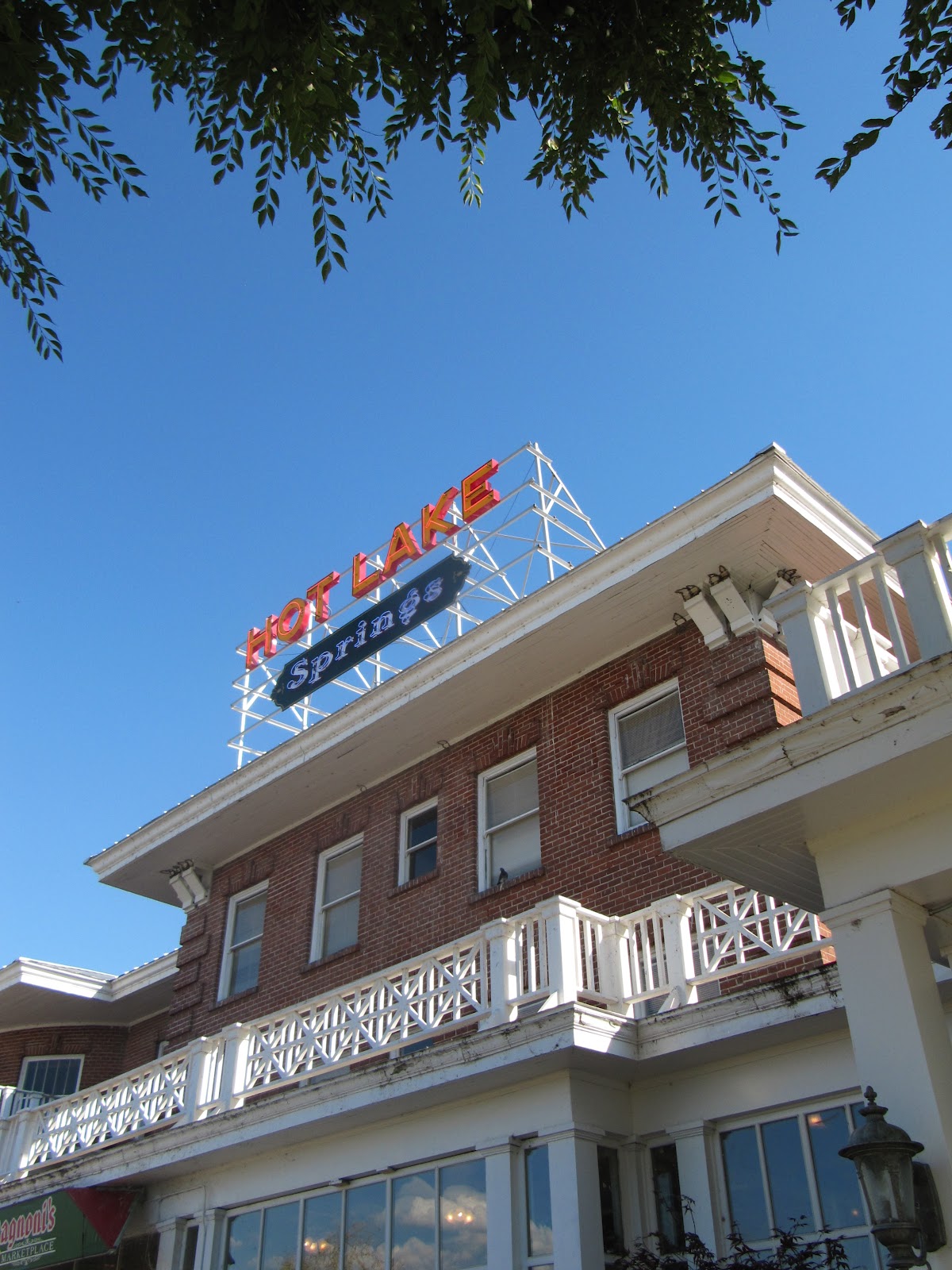
Hot Times at Hot Lake Springs

Hot Lake Springs
During the 1910s and 1920s it was the hottest spot in Oregon. Three daily trains from Portland brought hundreds of guests to “take the waters” at the Hot Lake Hotel and Sanitorium, a little southeast of La Grande. They would bathe in the hot mineral waters, soak in sulfuric baths, and wallow in mud from the lake’s sediment in an attempt to cure a variety of ills from rheumatism to syphilis.
Of course, it had always been a hot spot thanks to the 208-degree water that bubbles out of the ground creating a steaming, sulfurous lake. Native tribes knew about the water’s healing powers and considered the place holy ground. The first whites to enjoy the lake were fur trappers returning from Fort Astoria in 1812; later on, it was a welcome stopover for immigrants traveling the Oregon Trail.
In the 1860s, a number of wooden structures were built around the lake and, in 1908, a three-story brick hotel with hospital was added. The charismatic Dr. William Phy developed it into a state-of-the-art medical facility with labs, operating rooms, teaching hospital, and an innovative x-ray machine that seems more like a prop from a sci-fi horror film. It was often referred to as the Mayo Clinic of the West and attracted patients and spa seekers from all over the world.
Bathhouse and lake
In 1934, a fire destroyed the large wooden structure.  By then, Dr. Phy had died from pneumonia, the railroad was rerouted, the new highway bypassed the property, and the country had plunged into an economic depression. During World War II, it served as a training facility for nurses and later as a nursing home. Over time, the building fell into disrepair.  Vandals had broken all but two of the 360 windows, and looted the fixtures and marble tiles. Holes in the roof allowed water to damage floors and walls. Several attempts to save the structure failed and the future seemed grim for this piece of Oregon history.
At the same time, David Manuel was establishing a reputation as a renowned bronze sculptor and transforming the little town of Joseph in nearby Wallowa County into a noted art community.  He and his wife, Lee, frequently drove by the Hot Lake Hotel observing its sorry condition but also envisioning the property’s potential as a major tourist destination. In 2003 they sold off their interests in Joseph and bought the place. While the old hotel’s foundations were still sound, everything else was a mess and it would be a daunting and expensive task to restore it. Eight years, a lot of hard work, and over $12 million dollars later, Hot Lake Springs was back in business with its grand re-opening in August, 2011.
One of the B & B rooms
Twenty-two of the former hotel rooms have been transformed into a bed and breakfast. Since the rooms were decorated and furnished by local donors, no two are alike. There is a charming breakfast nook and an Italian restaurant on the premise as well as a theater, full service spa, indoor and outdoor soaking tubs. The Manuels also moved their bronze foundry to the site and guests can take a tour and watch a video describing the lost-wax casting process. Many of his pieces, mostly of wildlife and Western themes, are displayed in an on-premise art gallery. Manuel has maintained a long interest in Western art and history, especially Native American history, and a small museum contains an outstanding display of artifacts he has collected over the years.
Outside, there is an antique vehicle display, honor garden, and life-size bronze statue of “The Promised Land,” the same one that occupies Chapman Square in downtown Portland.
The Promised Land
To see more photos and artifacts from Hot Lake’s heyday, take a short drive south to the town of Union with its wonderful county history museum.  The display of medical apparatus and equipment used at the hospital will make you grateful to be living in the 21st century.
To make reservations or view the various rooms online, visit their website at www.hotlakesprings.com.  It is not necessary to be an overnight guest to enjoy the property and tour tickets are available at $10 for adults. This includes the history museum, bronze foundry (tours at 10:00 am and 2:00pm Monday through Saturday) and access to the grounds and indoor facilities.

Thursday, December 15, 2011

Portland Markets

With the number of days until Christmas dwindling, shoppers seeking local and handmade items should take advantage of two remarkable Portland institutions: the Portland Farmers’ Market and Portland Saturday Market.

Saturday, December 17, marks the end of the season for the Farmers’ Market at the PSU Campus, and the last opportunity for snapping up locally made and grown products. Non-perishable gift ideas include jams and jellies, hazelnuts, smoked salmon, locally processed sausages and pates, vinegars, chocolates and bags of chestnuts for roasting on an open fire. There are always plenty of seasonal fruits and vegetables (a great mushroom selection), plants, and flowers. The market is open from 9:00am to 2:00pm


A tram ride across town ends at the Saturday Market at Ankeny Plaza and Waterfront Park. Since 1974, this outdoor market has offered shoppers an opportunity to buy directly from local artists and craftspeople. You’ll find a wide variety of unusual, one-of-a-kind gifts from jewelry, handmade fashions, bent spoon art, duct tape wallets to a catnip filled body pillow for your favorite feline. There’s always music and entertainment, and a food court with ethnic cuisines from all over the world. While usually open on Saturday and Sundays only, The Festival of the Last Minute runs daily until Christmas Eve at 5:00pm.


Tuesday, April 19, 2011

Tillamook County Quilt Trail

The latest effort to spur tourism in rural areas while promoting an American folk art tradition and bringing communities together is the Quilt Trail. It all began with a quilter, Donna Sue Groves, in Adams County, Ohio. Groves, a field representative for the Ohio Arts Council, wanted to paint a single quilt square on her barn as a tribute to her mother, also an avid quilter. Other neighbors became interested in the idea and it was decided to paint 20 local barns with quilt squares, the number on an average quilt. The project would serve as a celebration of an Appalachian folk art tradition and encourage tourists to drive through the back roads of Southern Ohio.
Soon, quilt patterns, typically 8-foot-square, with colorful names like Brown Goose, Snail’s Trail, Broken Dishes, and Old Maid’s Puzzle began appearing on Adams County barns and a Clothesline of Quilts was born. The concept was so popular it soon spread to other Ohio counties. Quilting groups, 4-H clubs, art councils, tourism offices, and other community organizations embraced the idea, and quilt barns began appearing throughout Kentucky, Tennessee and other Appalachian states.
Today, Clotheslines of Quilts and Quilt Trails can be found in over 23 states and it is estimated over 1500 barns are painted with quilt squares. Oregon’s contribution to this concept can be found in Tillamook County, which has enjoyed a long tradition of dairy farming and has plenty of barns. This is the first Quilt Block Trail on the West Coast. The project began in 2009 by identifying historic barns and decorating them with painted, wooden quilt blocks. Most of the quilt patterns come from a book, Patterns for an Oregon Quilt, and were designed exclusively for Oregon. Pick up a brochure/map at the Chamber of Commerce center on Hwy. 101 next to the Tillamook Cheese Factory, Latimer Quilt & Textile Center (pdf map available at web site), or the wonderful Tillamook County Pioneer Museum. Not only does the brochure provide a detailed map to the 13 barns, but also a family history of each farm.