Friday, August 27, 2010

Burroughs Mountain Trail: Up Close with Mt. Rainier

Now that there is a distinct feeling of autumn in the air, it’s time to celebrate summer on Mt. Rainier. Between the end of August and the return of snow flakes exists a narrow window of opportunity to hike on the park’s higher elevation trails. The snow pack has at long last melted from most of the trails and the weather is often sunny, cool, and clear.
One of the most dramatic, knock-your-socks-off vistas can be found from the Second Burroughs and this seven-mile, 900-foot elevation gain trail is well worth the huffing and puffing. The trail, named for the 19th century naturalist and essayist, John Burroughs, begins at the Sunrise Visitor Center parking lot. From here, it climbs steadily up a meadow and along the Sourdough Ridge to Frozen Lake (1.5 miles) offering some pretty views along the way. From the lake, the trail leads upwards across an exposed, rocky slope to the First Burroughs (7200’). While the vista from here is photo-worthy, don’t give up! Continue the extra mile up to the Second Burroughs (7400’) where you will be rewarded with a breathtaking, 360-degree panorama including Mt. Rainier (so in your face), the Emmons Glacier, largest in the lower-48, and the Selkirk Mountains in British Columbia.
Here are some photos to motivate you!

The long slog to Second Burroughs


Mt. Rainier emerges from the clouds.


At the top of Second Burroughs

Picnic with a view!

Avoid the abyss!


Worth the effort!

Thursday, August 19, 2010

Clackamas County Fair

The Clackamas County Fair is on now until Sunday, Aug. 22 and it’s a wonderful opportunity to experience rural, small town Oregon within a short drive from Portland. As urban encroachments make traditional, rural lifestyle a disappearing part of the Portland area landscape, it’s great to see events like this fair thriving. If you can make it out to Canby this weekend, here are my favorite top five things to do:


5) Watch teenagers pamper pigs. Well, not just pigs, but sheep, llamas, cows, goats and roosters are looking sharp and smelling great in the livestock barns and show rings.


4) Take a ride. The carnival grounds are full of tummy-turning rides and others not nearly as scary as the looks on these kids’ faces would suggest.


3) Admire the talents of your artsy-craftsy neighbors. The main pavilion is stuffed with quilts, paintings, photos, knitting projects, canned beans, and doilies.


2) Tap your toes. The fair offers a wide variety of music from fiddlers to Sinatra crooners, all included in the price of admission.


1) Eat some pie. You might think of corn dogs and curly fries as the quintessential fair food, but check out the dozen or so pie selections offered by the Canby Methodist Church ladies. YUM!


Oh, and there is a rodeo every evening as well!

Have fun!

Tuesday, August 17, 2010

Woodburn: More Than a Mall

The back-to-school shopping frenzy is in full swing, and many folks will be making the trek to the Woodburn Company Stores, off I-5 between Portland and Salem. With over 100 stores, it is Oregon’s largest outlet center and the perfect place to pick up bargains.
Most shoppers rarely venture over the freeway to the east side and the town of Woodburn, and that’s a shame. They’re missing one of the most culturally diverse communities in Oregon, where the Chamber of Commerce welcomes people in English, Spanish, and Russian.
Settlemier House
The area was originally settled by Calapooya Indians and retired French-Canadian fur trappers, hence the name French Prairie. But it was the arrival of Jesse Settlemier in 1863 that led to the development of the town of Woodburn. Settlemier purchased land and established a nursery specializing in fruit and ornamental trees. When the Oregon and California Railroad arrived in the early 1870s, he platted the downtown section near the tracks and offered a city lot to anyone who would put a building on it.
The town of Woodburn grew quickly and Settlemier thrived as well. In 1892 he built a stunning, 14-room, Queen Anne Victorian home reflecting his wealth and status in the community. The property stands on a large, wooded lot on Settlemier Avenue and is owned and cared for by the French Prairie Historical Society. The home is open to the public on the first Sunday of every month.
President Obama ate here!
Agri-business has always been the life blood of Woodburn. Originally, the local economy was based on farm products including berries, hazelnuts, hops, and other fruits and vegetables. Today large nurseries and greenhouses dominate the scene and their labor-intensive operations have created a demand for year-round employees. Seasonal Mexican workers have been replaced by permanent laborers and their families. The Woodburn schools are now over 70% Hispanic and the downtown area is filled with thriving businesses catering to the needs and interests of the Hispanic community. In between the bakeries, shops, and taquerias (be sure to check out Luis's) on Front Street, is the Woodburn Historic Museum. The entrance is surrounded by a replica of an arch touting Woodburn as the World’s Berry Center, and inside is a collection of the town’s memorabilia from World War II recruitment posters to high school class photos. The museum is open Saturdays only.
Down the street, in the shadow of the water tower, is a delightful surprise for railroad buffs. Engine 1785 is a vintage, 1902 Southern Pacific steam engine beautifully restored by the Oregon Railway Historical Society. Engines like this once carried freight and passengers up and down the West Coast, and Union Pacific trains still whiz through the center of town.
In addition to its sizeable Hispanic population, Woodburn is also home to a large group of Russian Old Believers. These traditionalists broke away from the Orthodox Church during a period of reforms, and, for years, were persecuted by Tsarist and Communist Russia. During the Cold War, charities were instrumental in assisting Christians in migrating from Communist countries and over 10,000 Old Believers ended up in Oregon, mostly in the Woodburn area. South of town, their onion-domed churches are scattered across the farmland. The one at the end of Bethlehem Road with its gold domes and brightly painted façade is strikingly beautiful.
Nearby, on Howell Prairie Road, is the Bauman Farms store, a 4th generation family farm and garden center. In the summer, the grounds are a riot of color with display gardens and greenhouses full of flowers and humongous, hanging baskets. Inside, the season’s bounty of fruits and vegetables, homemade jams and jellies, and fresh bakery products may be purchased.
A visit to the town of Woodburn should certainly be on every outlet shopper’s list.

Thursday, August 5, 2010

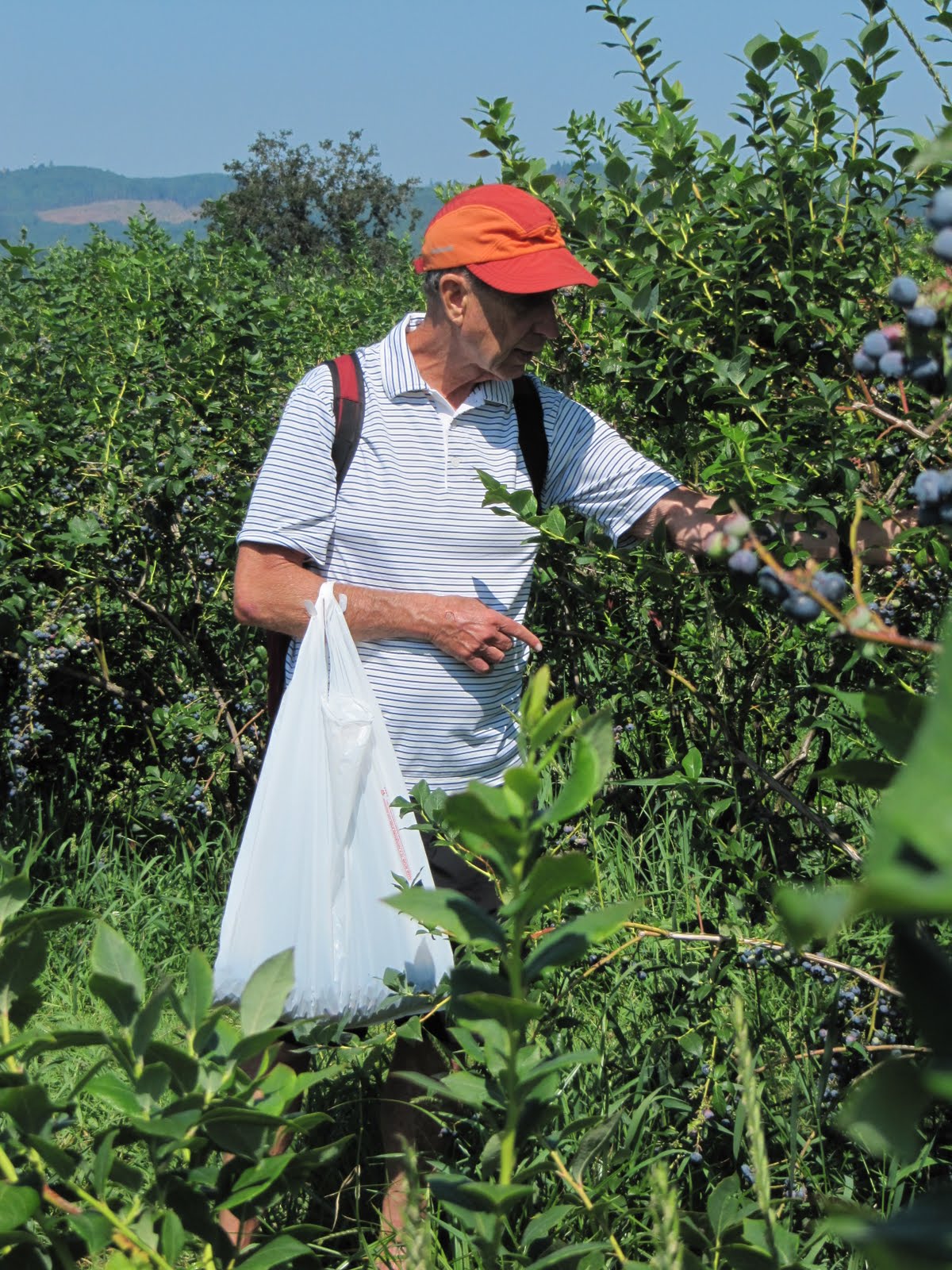
U-Pick 'Em Season

It's a time-honored tradition for many Portland families to pack up the kids, buckets, and baskets, and head out to Sauvie Island for some berry picking. This bucolic, agricultural oasis is only ten miles northeast of downtown Portland, but it could be a million miles away.
Sitting between the Columbia River and Multnomah Channel, the island is a mix of farms (mostly), wildlife refuges, and beaches. There are several U-pick places to chose from including Sauvie Island Farms, Kruger Farms, and Sauvie Island Blueberry Farm. In addition to berries, peaches, corn, cucumbers, and other summer fruits and veggies are available for picking. There are no better tasting berries than ones you pick yourself, and it's especially rewarding to take a baggie of berries from the freezer in February and remember the sunny, warm day of berry picking. A friend of mine from Denver had her first  picking experience here in Oregon, and was amazed to discover that blueberries actually had a distinct flavor! Have a berry good time!

Friday, July 30, 2010

Chemainus: The Little Town That Did

People reinvent themselves on occasion, and so do towns. One of the most famous examples here in the Northwest is Leavenworth, Wash. In the early 1960s, the once-booming lumber town was in serious decline. The sawmill closing and departure of the railroad switching yards had left Leavenworth with an ailing economy and lack of jobs. As the town became more and more run-down, local business leaders and residents turned to the University of Washington’s Bureau of Community Development for help in saving the community. A number of ideas were tossed around, but the concept of creating a theme town was the most popular. There were already several successful examples in the country including “Danish” Solvang, California, “Swiss” New Glarus, Wisconsin, and “German” Frankenmuth, Michigan. While Leavenworth had no single ethnic tradition, it did have an attractive alpine setting and the idea of creating a romanticized, Bavarian village seemed to be the best fit. Great efforts were taken to make the town as authentic as possible, and the result has been a smashing success.
A similar story unfolded in the town of Chemainus, BC, about 50 miles north of Victoria on Vancouver Island. Faced with a declining timber industry and the possible closure of the Horsehoe Bay Lumber Mill, the biggest employer, the town considered ways to lure in the many tourists driving up and down the island. They decided to turn the town into one giant, outdoor art gallery. Today, more than 35 murals and a dozen sculptures tell the story of the region's culture and history. Now, about one-half million visitors stop by every year to enjoy the show by foot, by car, or by trolly. Here are a few of the building-size murals:


Thursday, July 15, 2010

Corvallis' DaVinci Days July 16-18

This weekend, the college town of Corvallis will be hosting its most creative and regarded special event,  DaVinci Days offering a mash-up of music, art, science, and technology.
Among the state’s oldest towns, Corvallis was platted by Samuel Avery in 1847 at the confluence of the Marys and Willamette Rivers, about 80 miles south of Portland. It grew as a lumber, agricultural and regional trading center, and briefly served as capital of the Oregon Territory until supplanted by Salem. Things changed for the town in 1868, when the Oregon Assembly designated the private college of Corvallis Academy to be the first, state-supported institution for higher education. Known as the Agriculture College of the State of Oregon, it experienced several name changes over the years, and we know it now as Oregon State University.
The campus occupies a large chunk of real estate, almost 400 acres, and with more than 20,000 students, its influence on this small town is immense. The attractive campus features a number of historical structures and an open space designed by famed landscape architect, John Olmsted. Two years ago, the campus was designated a National Historic District, the only college in Oregon to be awarded this distinction.
While the school dominates one side of town, the centerpiece of the downtown area is the Benton County Courthouse. Dating back to 1888, it is the oldest Oregon courthouse still used for its original purpose. With its four stories, 110-foot clock tower, and bright white paint, the building resembles a giant, frosted wedding cake. While in the downtown area, be sure to check out the pleasant walking path along the Willamette River; the Book Bin, crammed with new and used books; and maybe try some homemade sweets at Bursts Chocolates.
Like most college towns, Corvallis offers a wide selection of cultural events. The focal point of the local art scene, The Arts Center, is located in a former Episcopalian church and is known for its exhibitions of local and national artists, and music concert series. In downtown, the Majestic Theater, a restored 1913 vaudeville house, offers live theater and old movies. The university, with its performances, exhibits, and lectures, adds to the vibrant cultural life, and an assortment of fairs and festivals during the year enliven the mix. Corvallis enjoys a reputation for being one of the greenest communities around, even by Oregon standards. Last year, it was voted Best Green City in the nation by Country Home magazine, and according to a recent EPA report, Corvallis buys more power from renewable sources than any other city in the country. There are miles of bike paths and visitors can tour the town in a human-powered pedicab.
Beyond town, there are numerous attractions depending on your interests. In nearby Philomath is the Benton County Historical Society Museum. Located in a 1867 brick building that once housed Philomath College, the museum offers an eclectic collection of items including at 1904 Oregon State College beanie, 1957 Kodak Brownie Starlight camera, a large collection of fluorescent rocks, 1927 Buck Rogers wind-up spaceship, a bright red rotary dial telephone, and much, much more. Also of historical interest are several close-by covered bridges and the Soap Creek Schoolhouse, a cute one-room school in rural Soap Creek Valley.
  Birders will enjoy visiting any of the three local, national wildlife refuges; oenophiles will find several nearby wineries to sample, and sports fans will want to check out OSU’s game schedule.

Friday, July 9, 2010

The Town That Oysters Built

It was the city of San Francisco awash with wealth from the gold fields and miners with an insatiable craving for oysters that created the town of Oysterville, Washington. Located at the end of the Long Beach Peninsula, due north of the mouth of the Columbia River, the site along Willapa Bay was well known to local Native American tribes. The vast, shallow bay was flush with oysters, an important part of the coastal Indians’ diet. After a local chief introduced pioneers Robert Espy and I.A. Clark to this culinary treasure trove, the great oyster rush was on.
By the summer of 1854, the town was booming. Large schooners from San Francisco were sailing into the bay and filling their holds with fresh oysters. Oysters were purchased with gold coins and it is claimed that Oysterville possessed more gold per capita than any other Pacific Coast town outside of San Francisco. Fortune seekers, fishermen, shopkeepers arrived and the town grew rapidly to over 800 in population and boasted of three hotels, five saloons, and a weekly newspaper. It served as the county seat of Pacific County.
The oyster business was hugely profitable and residents built attractive houses, many constructed from California redwood brought up the coast as ballast in the oyster schooners. Soon, a school, churches and other trappings of civilization arrived.
But, like most booms, it eventually went bust. Over-harvesting depleted the native oyster supply and the long-anticipated Ilwaco Railway and Navigation Company rail line stopped just south of town, leaving Oysterville isolated at the northern end of the peninsula. The final blow came in 1893 when a band of raiders from the town of South Bend on the east side of Willapa Bay sailed across the water, ransacked the courthouse, stole all the official county records, and proclaimed South Bend to be the new county seat.
Over time, winter weather and shifting sands along the bay destroyed the business area leaving only a few residences, church, school, cannery and post office. Eighty acres of this quaint, ghost town were designated a National Historic District in 1976. The few remaining residents work hard at maintaining the village’s unique character and have established the Oysterville Restoration Foundation to protect, preserve, and restore the buildings and sites of historic interest.
Looking more like a movie set of a New England coastal village, Oysterville offers visitors a glimpse of an unusual 19th century Washington town with its picturesque houses, restored church and schoolhouse, and rows and rows of picket fences. The sole surviving church, with its tall, white and red striped steeple is easy to locate. Built in 1892, it began life as a Baptist church and is now nondenominational. The front door is always unlocked and a supply of walking tour brochures is available in the foyer. Following the tour route by foot or car takes visitors to all the points of interest in the historic district and includes a brief history of all the properties.
Of special note are the impressive Esby, Crellen, and Stoner houses overlooking the bay and the charming Captain Stream cottage. The schoolhouse, located on School Road, of course, was used until 1957 and currently serves as a community center. The old cannery on the waterfront is now the Oysterville Sea Farms and sells a variety of fresh seafood including oysters and other local, seasonal farm and bakery products. The deck at the rear of the store offers an unmatched view of Willapa Bay and is a great spot to enjoy a snack.
There are many other attractions on Long Beach Peninsula and the area has served as a popular beach resort for decades. One place not to miss is the informative Pacific Coast Cranberry Research Foundation Museum and Gift Store (open April through mid-December) where you can discover more about cranberries than you ever thought you would want to know.
To learn more about Oysterville and the area in general, visit http://www.funbeach.com/.